
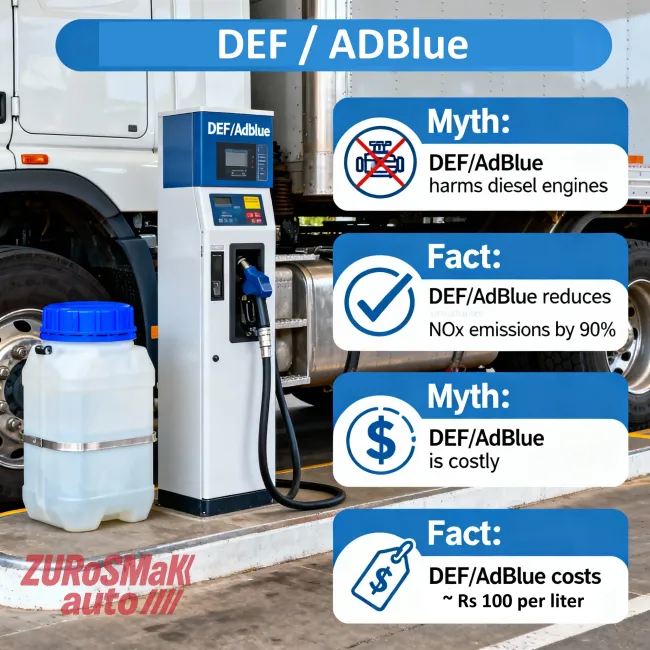
AdBlue (DEF) confusion mostly stems from how SCR works; it is not a fuel additive, never enters the engine, and—used correctly—cuts NOx without harming performance [3][4][1][2].
Disclaimer: Always follow the owner’s manual and ISO 22241 requirements; never dilute or add anything to the DEF tank, and use only compatible materials and clean equipment [5][6][7].
🔎 What AdBlue/DEF Is
AdBlue and DEF are the same AUS 32 fluid: 32.5% high-purity urea in deionized water used by Selective Catalytic Reduction (SCR) to convert NOx to nitrogen and water in the exhaust stream [1][2][5].
The fluid sits in a dedicated tank and is metered into the hot exhaust upstream of the SCR catalyst; it never mixes with diesel or circulates inside the engine or fuel system [3][4].
🧯 Top Myths vs Facts
| Myth | Fact | Why It’s Wrong |
|---|---|---|
| “AdBlue is a fuel additive.” | It is injected into the exhaust, not the diesel tank. | SCR dosing occurs post-combustion, so DEF never touches fuel or the engine. |
| “AdBlue damages engines.” | It does not enter the engine; issues arise from contamination or off-spec fluid harming SCR components. | ISO 22241 purity protects pumps, injectors, sensors, and catalysts from ionic/particulate contamination [5]. |
| “More DEF improves power.” | Dosing is ECU-controlled and unrelated to engine output. | Over- or under-dosing triggers faults without any power benefit. |
| “AdBlue and DEF are different.” | They refer to the same AUS 32 fluid class; “AdBlue” is a VDA trademark. | Both must comply with ISO 22241 to be vehicle-safe [5]. |
| “It’s just urine and water.” | It is high-purity synthetic urea and deionized water. | DIY mixes lack purity and will poison the SCR system. |
| “It freezes, so it’s useless.” | It freezes around −11°C but safely re-liquefies if uncontaminated. | Systems include heaters; properties recover after thawing [10]. |
| “Dilute with water to save money.” | Never alter concentration or add tap water. | Breaks ISO spec and can destroy catalysts and sensors. |
| “It’s hazardous and flammable.” | It’s non-toxic and non-flammable, but mildly corrosive to some metals. | Use compatible materials and rinse spills with water. |
| “Any container will do.” | Use HDPE or stainless (304/316) equipment only. | Copper/brass/zinc/steel can leach ions that degrade fluid and SCR parts [6][7]. |
| “You can run without DEF.” | Vehicles derate or won’t restart when the tank is empty; tampering is illegal. | SCR is emissions-critical; bypassing risks fines and warranty loss [8]. |
🧪 Handling and Storage
Buy ISO 22241-compliant fluid, keep containers sealed and shaded, store near 10–30°C, and observe typical 12–18 month unopened shelf life when handled correctly [5][7].
Clean spills with water and keep funnels/hoses DEF-dedicated; any contact with fuel, oil, or coolant contaminates the system [6].
🇮🇳 India-Specific Notes
Under BS6, SCR is common on heavy-duty diesels and many large diesel SUVs across India, and DEF is widely available at truck stops, fuel stations, and OEM dealers [8].
Heat and dust make hygiene critical—keep caps closed, avoid open-yard decanting, and prefer sealed, branded packs or certified bulk dispensers [7].
❓ Quick FAQs
- Misfilled into diesel tank? Do not start; drain and flush immediately [3].
- Diesel in the DEF tank? Treat as contamination; replace fluid and inspect dosing hardware [7].
- Why 32.5% urea? It optimizes NOx conversion and sets the eutectic freeze point near −11°C [1][5].
- Crystals on the filler? Rinse with clean water; avoid scraping with metal tools [7].