
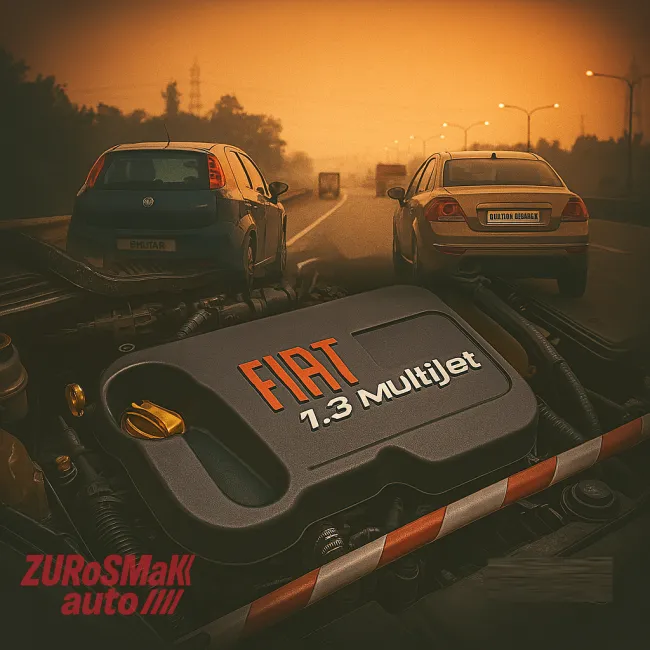
For a generation of Indian drivers, the Fiat 1.3 Multijet wasn’t just an engine; it was a quiet companion that made everyday commutes effortless and long highway runs possible on a shoestring, earning a fond nickname as India’s “national diesel engine” in its twilight years [2][9].
In a market that needed dependable torque, frugality, and fuss-free cruising, this compact turbodiesel showed how smart engineering could feel bigger than numbers—steady, tractable, and always ready to go the distance [1][2][10].
🔧 Where It Came From
The 1.3 Multijet (Fiat’s second-generation common-rail JTD) debuted with multi-injection control—several tiny fuel pulses per cycle that tamed noise and sharpened efficiency—packaged in a compact 1,248–1,251 cc, 16-valve, turbo-intercooled layout [3][1][11].
This architecture arrived in India like a perfect fit: Euro-class combustion finesse meeting local realities of heat, load, and traffic, with later VGT tunes adding mid-range muscle without losing thrift [3].
🚗 Power That Fiat India
Across its life, factory tunes spanned roughly 70–95 PS and 170–210 Nm depending on turbo and calibration, translating into relaxed city pull and easy highway pace in small cars and sedans alike [1][10].
| Model (India) | Engine Tune | Power/Torque | Notes |
|---|---|---|---|
| Fiat Punto/Grande Punto | 1.3 Multijet (fixed/VGT) | ≈ 90–92 bhp, 209 Nm | Balanced city torque and highway economy [5][7][12][13] |
| Fiat Linea/Linea Classic | 1.3 Multijet (various tunes) | ≈ 75–92 bhp, up to 209 Nm | Relaxed cruiser with steady mid-range [6][8][14][15] |
🪛 Why Owners Swore By It
With regular oil and filter care—and a watchful ear for timing-chain chatter at higher mileages—the 1.3 MJD proved a tough long-runner, often opening up only for neglect or misfuelling, not design weakness [2][9].
Localized manufacturing and wide adoption meant parts, know-how, and tune familiarity spread quickly—confidence that kept families and fleets moving year after year [2][1][10].
While Fiat engineered and refined the 1.3 Multijet, its true impact came from how widely it was adopted. Licensed to multiple manufacturers, the engine appeared under various brand names—DDiS (Maruti Suzuki), Quadrajet (Tata Motors), Smartech (Chevrolet), and CRDi4 (Premier)—powering over two dozen models [2][9][1].
From hatchbacks to MPVs, sedans to compact SUVs, the Multijet became India’s go-to diesel heart—quiet, torquey, and frugal. Below is a breakdown of notable vehicles that carried this engine across brands.
| Model (India) | Brand Name | Power/Torque | Notes |
|---|---|---|---|
| Maruti Swift (Diesel) | DDiS | ≈ 75 bhp, 190 Nm | First mass-market diesel hatch with Multijet; huge success [2] |
| Maruti Dzire | DDiS | ≈ 75 bhp, 190 Nm | Popular compact sedan; known for fuel efficiency [9] |
| Maruti Ertiga (Gen 1) | DDiS | ≈ 90 bhp, 200 Nm | Family MPV with strong mid-range torque [2] |
| Maruti S-Cross | DDiS 200 | ≈ 90 bhp, 200 Nm | Premium crossover with refined diesel feel [9] |
| Tata Indica Vista | Quadrajet | ≈ 75 bhp, 190 Nm | Affordable diesel hatch with spacious cabin [9] |
| Tata Manza | Quadrajet | ≈ 90 bhp, 200 Nm | Spacious sedan with relaxed highway manners [9] |
| Chevrolet Sail | Smartech | ≈ 75 bhp, 190 Nm | Budget diesel sedan with GM badge [9] |
| Premier Rio | CRDi4 | ≈ 75 bhp, 183 Nm | India’s first compact SUV with Multijet [9] |
Each of these vehicles carried the same core DNA—quiet combustion, linear torque, and low running costs. Whether branded as DDiS, Quadrajet, or Smartech, the Multijet’s soul remained unmistakable.
📜 The Goodbye That Stayed
BS6 arrived in 2020, and rather than re-engineer the aging architecture, many brands pivoted to newer diesels—or stepped away from small diesels altogether—closing a chapter that had democratized torque for millions [2][9].
The sentiment lingers because it made India’s everyday diesel experience feel refined and attainable; in modest hatchbacks and sensible sedans, it quietly raised expectations for what “small” could do [2][3][11].
🧭 What It Leaves Behind
As a piece of engineering culture, the 1.3 Multijet stands for clever combustion—small injections, big difference—turning spreadsheets into lived reliability and giving countless first highway memories their soundtrack [3][2][11].
On paper it was 1.3 litres; on the road, it was the friend that simply started and went, through monsoons, heatwaves, and everything in between [2][9].