
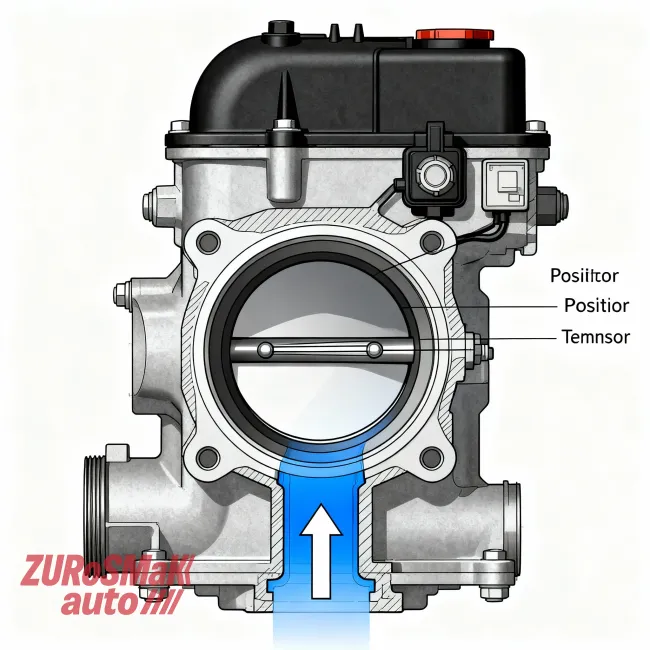
The throttle body is one of the most critical components in your vehicle's air intake system, acting as the gateway that controls how much air flows into your engine. This seemingly simple device plays a fundamental role in engine performance, fuel efficiency, and overall vehicle operation.[1][2]
🔧 What Is a Throttle Body?
A throttle body is a housing unit that contains a throttle plate (also called a butterfly valve) that rotates on a shaft to regulate airflow into the engine. Located between the air filter and intake manifold, it serves as the primary control mechanism for engine power by managing the air-fuel mixture essential for combustion.[2][3][4]
When you press the accelerator pedal, the throttle plate opens to allow more air into the engine, which triggers the fuel injection system to deliver a proportional amount of fuel. This precise coordination between air and fuel creates the combustion needed to generate engine power.[1]
⚙️ How Does a Throttle Body Work?
Modern throttle bodies operate through two main systems:
- Cable-driven (Mechanical): Connected directly to the accelerator pedal via a throttle cable, providing immediate mechanical response[3]
- Electronic (Drive-by-Wire): Uses sensors and electronic actuators controlled by the Engine Control Unit (ECU) for precise throttle management[4]
The throttle position sensor (TPS) continuously monitors the throttle plate's angle and communicates this information to the ECU. Based on this data, along with inputs from other sensors like the mass airflow sensor, the ECU calculates the exact amount of fuel needed to maintain optimal engine performance.[1]
🚨 Signs of a Failing Throttle Body
Recognizing the symptoms of a malfunctioning throttle body can prevent more serious engine problems:
- Poor acceleration response: Sluggish or delayed throttle response when pressing the gas pedal[5][6]
- Rough idling or stalling: Engine shaking, vibrating, or shutting off unexpectedly at idle[7][5]
- Check engine light: ECU detects throttle body malfunctions and triggers warning lights[8][5]
- Reduced fuel efficiency: Improper air-fuel mixture leads to increased fuel consumption[5][7]
- Engine entering limp mode: Vehicle severely limits power to protect against further damage[7]
🛠️ Maintenance and Cleaning
Regular throttle body maintenance is essential for optimal engine performance. Over time, carbon deposits, dirt, and oil residue can accumulate inside the throttle body, restricting airflow and causing performance issues.[9][7]
Cleaning Process: Professional cleaning involves removing the throttle body and using specialized solvents to remove buildup from the throttle plate and housing. This maintenance should typically be performed every 75,000-100,000 miles, depending on driving conditions.[5]
Replacement Considerations: If cleaning doesn't resolve performance issues, throttle body replacement may be necessary. Replacement costs can range from under $100 to over $700, depending on the vehicle make and model.[1]
🔄 After Replacement: Calibration
When installing a new throttle body, proper calibration is crucial. Modern vehicles require a throttle relearn procedure to allow the ECU to recognize the new component and adjust the air-fuel ratio accordingly. This process typically involves:[10]
- Turning the ignition to "on" position without starting the engine for 10-15 minutes
- Allowing the system to automatically calibrate during normal driving
- Using diagnostic tools for precise calibration in some vehicles
📈 Performance Enhancement
Some enthusiasts install throttle body spacers—metal discs placed between the throttle body and intake manifold to increase airflow velocity and potentially improve horsepower and fuel economy. However, the actual performance gains from these modifications are often minimal in modern fuel-injected engines.[2]